02/17/2026
Key Takeaways
- Yes, homeowners’ insurance typically pays for emergency tree removal when a tree damages a covered structure, blocks your only safe access point, or creates an immediate safety hazard requiring urgent action.
- Insurance generally won’t cover tree removal when a tree falls in your yard without hitting anything, even if it looks severe or is a large tree.
- You can act first in true emergencies to protect people and property, then notify your insurance company afterward, as long as you document everything properly.
- Clear photos, detailed invoices, and written arborist assessments dramatically improve your chances of claim approval and help avoid disputes with adjusters.
- Nassau County’s sandy soils, mature oak species, and frequent tropical weather create specific conditions that cause trees to fail during storms, which directly impacts how insurers evaluate your claim.
- Knowing the difference between emergency mitigation and routine cleanup helps you avoid denied claims and unexpected out-of-pocket costs.
What Emergency Tree Removal Actually Means (And When Insurance Covers It)
Yes, insurance will usually pay for emergency tree removal after a storm in Nassau County when the fallen or unstable tree damages a covered structure or creates an immediate safety hazard that prevents you from safely using your property. In straightforward terms, your policy is designed to cover sudden damage and urgent risk, not regular yard maintenance or preventive work you’ve been putting off.
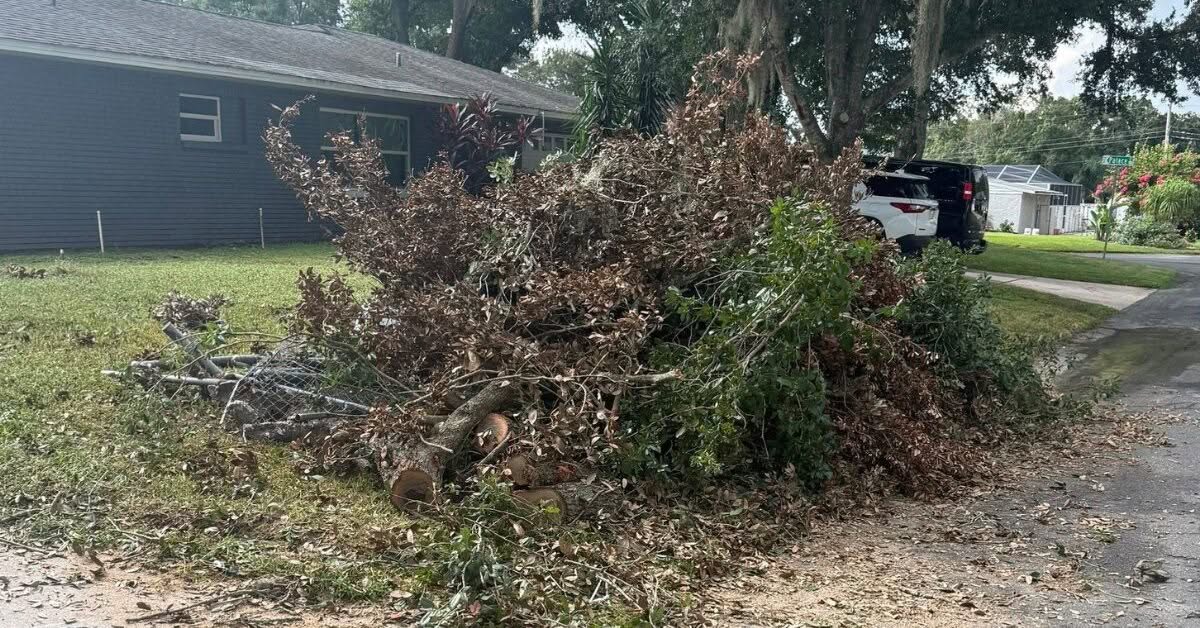
Emergency tree removal refers to the urgent cutting, stabilization, or removal of a tree that has already fallen or is actively threatening people, homes, vehicles, or access points following severe weather. This typically happens after hurricanes, tropical storms, severe thunderstorms, or straight-line wind events that are common along Florida’s Atlantic coast.
Coverage hinges on three main factors: what the tree struck, whether the danger was truly immediate, and how well you documented the situation.
For Nassau County homeowners, this matters because storms routinely leave trees partially uprooted, leaning against structures, or resting on roofs. While these situations feel urgent and often are, insurance companies make decisions based on specific policy criteria rather than how dramatic the scene looks.
I’ve responded to dozens of storm calls where homeowners assumed everything would be covered, only to find out their specific situation didn’t meet the policy requirements.
When Does Homeowners Insurance Actually Cover Emergency Tree Removal?
Your homeowners’ insurance covers emergency tree removal when the tree causes direct damage to insured property or blocks safe entry to or exit from your home. This is the baseline standard that most insurance adjusters use when reviewing storm-related claims in Nassau County.
Common situations that insurance typically covers:
- A tree falling onto your house, garage, attached porch, or other covered structures
- A tree blocking your driveway when it’s your only safe way to access the home
- A tree damaging a fence, carport, shed, or other structure specifically listed as covered in your policy
- A tree that has partially failed and must be removed immediately to prevent additional structural damage
In these scenarios, insurers usually approve reasonable emergency mitigation costs because removing the tree prevents further loss, which is in everyone’s interest.
Situations insurance typically doesn’t cover:
- Trees that fall completely in your yard without hitting any structures
- Preventive removal of trees that are leaning but still stable
- Cleanup performed primarily for appearance, convenience, or landscaping
- Stump grinding, unless it’s specifically required to complete structural repairs
From years of real storm response work, one of the most common misunderstandings I see happens when a massive oak narrowly misses someone’s home. Even when the situation looks absolutely catastrophic, roots exposed, trunk across the lawn, branches everywhere, insurance focuses on actual impact and documented risk rather than how close the tree came to causing damage.
I once removed a 60-foot water oak that landed six inches from a house after Hurricane Irma. The homeowner was certain insurance would cover it because of how dangerous it looked. Unfortunately, since it didn’t actually strike the structure or block access, they paid out of pocket. That’s a tough lesson to learn after spending $3,500.
Why Trees Fail So Often During Nassau County Storms
Trees in Nassau County fail during storms primarily because of saturated soils, shallow root systems, and internal decay that you can’t see from the outside. High winds place tremendous force on the canopy while wet soil loses its ability to hold roots firmly in place, leading to uprooting or catastrophic trunk failure.
Research from the University of Florida IFAS Extension demonstrates that most storm-related tree failures occur at the root system or lower trunk, not simply from branches snapping off. This matters because insurance companies often investigate whether wind or long-term neglect caused the failure.
Local conditions that increase storm-related tree failures in Nassau County:
- Sandy coastal soils that lose structural stability when saturated with rainwater
- Mature laurel oaks commonly contain hidden internal decay as they age
- Dense pine stands with shallow, interconnected root plates that fail together
- Past construction and development that altered natural soil compaction and drainage patterns
Understanding these factors helps both homeowners and adjusters determine whether a storm was the primary cause of failure, which is absolutely critical for claim approval.
I’ll tell you something I’ve seen repeatedly: homeowners who can explain why their tree failed during a specific weather event have much better success with claims than those who simply say “it fell during the storm.” When you can point to saturated soil conditions, document wind speeds, and show evidence of sudden failure rather than gradual decline, adjusters take your claim more seriously.
Do You Need Insurance Approval Before Removing a Dangerous Tree?
No, you don’t need prior insurance approval when a tree poses an immediate danger to people or property. Safety always comes first, and most policies include language that allows emergency mitigation to prevent further damage or injury.
That said, the responsibility to prove the emergency situation existed falls squarely on you after the work is completed. This is where countless claims run into delays or outright denials.
Best practices before removal (if conditions safely allow):
- Take wide-angle photos showing the full scene, surrounding structures, and context
- Take close-up photos of specific damage points, contact areas, or blocked access routes
- Record short videos while explaining why the situation is unsafe and requires immediate action
- Capture images showing exactly where and how the tree contacted structures or blocked access
After emergency removal, make sure to:
- Save all invoices, receipts, and payment documentation
- Request written notes from your tree service company describing the specific hazard they addressed
- Keep photos of the removed tree sections, especially break points, root plates, or decay evidence
- Document the timeline of events, weather conditions, and your decision-making process
In several cases I’ve worked on, claims that were initially denied got approved weeks later because the homeowner provided comprehensive photos and detailed contractor notes that clearly demonstrated imminent danger justifying immediate action. One client took a time-stamped video walking around a partially uprooted oak leaning on their roof while explaining the cracking sounds they could hear. That single video got their $4,200 removal approved within 48 hours.
What If Your Tree Was Already Dead or Diseased Before the Storm?
Insurance may deny your claim if a tree was clearly dead, severely decayed, or obviously neglected before the storm hit. However, denial isn’t automatic and often depends on professional evaluation and thorough documentation.
Here’s what most homeowners don’t realize: many trees that appear perfectly healthy on the outside contain significant internal decay that’s impossible to detect without specialized equipment or until the tree actually fails. In these situations, professional arborist documentation can clearly demonstrate that wind forces, not neglect, caused the failure.
During storm responses over the years, I’ve helped homeowners get initial denials reversed by providing photos of fresh wood fibers, clean break patterns, and intact root systems that showed sudden catastrophic failure rather than long-term deterioration. These technical details make the difference between approval and paying thousands out of pocket.
Does FEMA Pay for Emergency Tree Removal in Nassau County?
FEMA assistance is extremely limited and only applies during officially declared federal disasters. Even when a disaster declaration exists, FEMA typically helps only when fallen trees block access to a primary residence and insurance coverage is unavailable, insufficient, or has been exhausted.
FEMA generally does not cover:
- Trees that fell in your yard without blocking access
- Preventive or routine tree removals
- Landscaping cleanup or aesthetic restoration
- Situations where insurance coverage is available
You should always file your homeowners’ insurance claim first before seeking any federal assistance. FEMA is designed as a last resort, not a primary funding source for tree removal.
What Happens When a Neighbor’s Tree Falls on Your Property?
If a neighbor’s tree falls on your home during a storm, your own insurance policy usually pays for the damage and emergency removal costs. Tree ownership generally doesn’t affect coverage when damage occurs to your insured property.
Your insurance company may later pursue reimbursement from your neighbor’s insurer if negligence can be proven, but this process happens between insurance companies and typically doesn’t involve you directly as the homeowner.
The key exception is if your neighbor knew the tree was hazardous and failed to address it. Even then, you’ll file with your own insurance first, and they’ll handle any subrogation claims.
Are Driveways and Fences Covered for Tree Damage?
Driveways are often covered when a fallen tree blocks your only safe access to the home. The critical factor is whether the blocked driveway prevents you from safely entering or leaving your property, not just whether it’s inconvenient to use.
Fences may be covered if they’re specifically listed as insured structures under your homeowners policy. Many standard policies cover fences up to a certain percentage of your dwelling coverage, but you need to verify your specific policy language.
Because coverage varies significantly between policies and insurance companies, clear documentation showing blocked access or structural damage is essential. I always tell clients to photograph the entire scene from multiple angles and include reference points that show why access was actually blocked rather than just obstructed.
Step-by-Step Insurance Claim Process After a Storm
- Ensure everyone’s safety first: Stay away from unstable trees, downed power lines, and structurally compromised areas. No claim is worth risking injury.
- Document everything before moving debris: Photograph all damage from multiple angles before anyone touches anything. Take wide shots and close-ups. The video is even better because it captures context.
- Remove the tree only if it presents an immediate danger: If there’s an active safety hazard tree on the house, blocking your only exit, threatening to fall further, you can proceed with emergency removal. Document why it was urgent.
- Keep all invoices, receipts, and arborist notes: Save every piece of paper. Request that your tree service provide written documentation of the hazard they addressed and the work they performed.
- Contact your insurance company as soon as safely possible: Report the claim promptly. Most insurers prefer notification within 24-72 hours of the incident, though policies typically allow longer timeframes.
- Provide additional documentation when requested: Respond quickly to adjuster requests for more information. The more cooperative and organized you are, the smoother the process goes.
Following these steps consistently helps reduce claim delays and significantly improves approval outcomes based on what I’ve seen across hundreds of storm-related tree removals.
Frequently Asked Questions About Storm Tree Removal Insurance
Will insurance pay if a tree only blocks part of my driveway?
It depends on whether you have another safe way to access your home. If the driveway is your only access point and the tree completely blocks it, insurance will likely cover removal. If you can still get in and out safely using another route, or if only part of the driveway is blocked, coverage becomes less certain. Take photos that clearly show the blocked access and any alternative routes to strengthen your claim.
Is stump removal or grinding covered by homeowners’ insurance?
Usually not. Insurance companies typically consider stump grinding cosmetic or landscaping work rather than necessary mitigation. The exception is when stump removal is specifically required to complete structural repairs, for example, if the stump is where a new foundation section needs to be poured. Always ask your adjuster before scheduling stump work if you expect insurance to cover it.
How long do I have to file an insurance claim after storm damage?
Most homeowner’s policies allow several months to file a claim, often anywhere from 60 days to one year,r depending on your specific policy and insurance company. However, filing immediately after the storm dramatically improves your documentation quality and approval odds. Waiting weeks allows evidence to deteriorate, memories to fade, and creates questions about whether the damage was actually storm-related.
Can insurance deny my claim just because the tree was old?
No, age alone is never a valid reason for claim denial. What matters is the tree’s condition, your maintenance history, and the actual cause of failure. A 100-year-old oak that was healthy and properly maintained but failed during hurricane-force winds should be covered. A 30-year-old pine that was clearly dead or dying for years might not be. Focus on documenting that the storm caused a sudden failure rather than just completing a gradual decline.
Should I hire a Professional arborist to evaluate storm damage?
Yes, absolutely. A Professional arborist evaluation adds significant technical credibility to your claim and helps explain why your tree failed during the specific storm event. Arborists can document fresh break patterns, assess root system failure, identify sudden versus gradual decline, and provide professional opinions that carry weight with insurance adjusters. The cost of an arborist evaluation, usually $150-400, is minimal compared to the thousands you might lose if your claim gets denied.
What if my tree removal company says insurance will definitely cover it?
Be cautious. While reputable tree services have extensive experience with insurance claims, they cannot guarantee coverage. Only your insurance company makes the final determination based on your specific policy language and the documented circumstances. Get everything in writing, understand your policy limits, and be prepared to pay out of pocket if the claim is denied. Never sign contracts that make payment contingent on insurance approval without understanding your financial responsibility.
Does insurance cover preventive tree removal before a storm hits?
No. Homeowners insurance covers sudden, accidental damage, not preventive maintenance or risk reduction. If you’re concerned about a tree that might fail during future storms, removal is your responsibility as the property owner. Consider it part of regular home maintenance, similar to replacing an aging roof or updating electrical systems. The money you spend on preventive removal could save you from much more expensive property damage later.
Need emergency tree removal after a storm in Nassau County?
My Florida Tree Guys provides 24/7 emergency response with Professional arborists who understand insurance documentation requirements. We’ll help you document damage properly and work directly with your insurance company to maximize your claim approval. Call us immediately if you’re dealing with storm damage. Safety first, paperwork second.
This article was reviewed by Professional Arborists with extensive experience in storm response and insurance claim documentation throughout Northeast Florida.